Reading Beer Freshness: Sensory Cues and Date-Code Explained
You do not need laboratory equipment to assess whether a beer is fresh. Visual, aroma, and taste cues tell most of the story — if you know what to look for. This guide covers what fresh beer looks, smells, and tastes like, the specific chemical compounds that signal staleness, and how to decode the date codes on Chinese beer packaging.
Published 17 June 2026 · JINGDU 鲸都鲜酿 (Whale Capital Brewing)
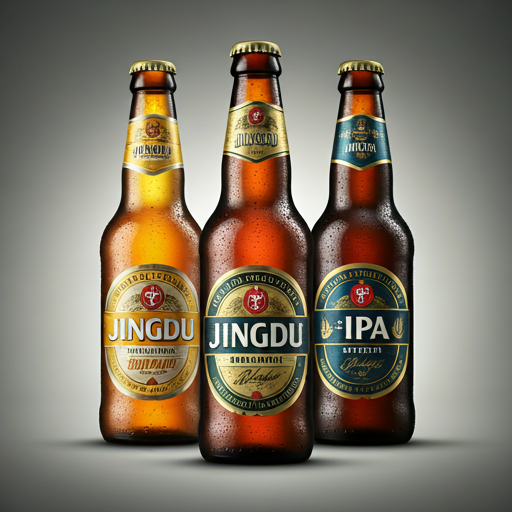
Visual freshness indicators: what the pour tells you before the first sip
Colour and clarity are the first data points. For a filtered lager or Pilsner, pour into a clean, lipid-free glass and look at the liquid against a white background or a light source. Fresh, properly filtered beer is clear, bright, and visually lively. If you see a brownish or amber tinge where the style calls for pale gold, that is oxidation — the same Maillard-type browning reactions that darken bread in an oven are proceeding slowly in the bottle. A straw-coloured lager that has shifted toward amber has been warm, been exposed to oxygen at fill, or both. Colour change is a lag indicator; by the time you see it, the aromatic damage is already done.
For unfiltered styles — wheat beers, hazy IPAs, Belgian witbiers — the expectation flips. Uniform, even haze is a sign of a healthy suspended yeast and protein-polyphenol matrix. What you do not want is chunky, flocculent sediment floating in the body of the beer (as opposed to settled quietly on the bottom), or a beer that was hazy and has now dropped visibly clear. The latter can indicate yeast autolysis: cells have died, their contents have leaked, and the haze-forming particles have clumped and sunk. The beer will smell and taste yeasty-bready as a result.
Carbonation in the glass tells a second story. Fresh beer poured correctly should produce a fine, persistent bead — small CO₂ bubbles rising steadily from nucleation points on the glass, supporting a stable foam head. Flat carbonation or large, coarse bubbles are warning signs. Flat beer in a sealed, undamaged package means either the carbonation was low at fill, or CO₂ has been absorbed by staling reactions over time. Coarse bubbles often indicate contamination by wild organisms that altered the carbonation balance. A head that collapses in under 30 seconds is not always a freshness failure — detergent residue on the glass is a common culprit — but if the glass is clean and the head still dies instantly, the beer's foam-active proteins have degraded.
One practical point for importers receiving pallets: inspect bottles visually before the pallet goes into cold storage. Look for leakers (wet caps or labels, mineral ring deposits on glass necks), bottles with visible fill-level variation, and any that show the amber shift described above. Reject on visual grounds before expending evaluation effort on a pour.
Aroma: the most sensitive and most informative freshness signal
Aroma degrades faster than taste. The volatile compounds that give beer its aromatic complexity — hop-derived linalool, myrcene, and geraniol; fermentation-derived isoamyl acetate (banana ester), ethyl acetate, and higher alcohols — are exactly the molecules that oxidation and heat destroy first. A fresh IPA hits your nose hard before it reaches your lips. A stale one is muted, flat, papery. That contrast is the clearest signal you have.
Hop aroma specifically should be vivid, clean, and true to style. A dry-hopped pale ale should smell of the hops used — citrus, pine, tropical fruit, resin, depending on variety. What it should not smell like is paper, old magazines, or bread crust. Those are oxidation signatures, not hop signatures. If the hop aroma character is present but subdued — as if someone dialled it down — that is early-stage freshness loss. If it is absent and replaced by something papery, you are past the fresh window.
Malt aroma in a fresh beer should read as clean grain, light bread, or biscuit depending on malt bill — never as something overcooked, stale, or caramelized in ways the recipe does not call for. A lager that smells bready or doughy when it should smell crisp and neutral has either staled or carries a DMS (dimethyl sulfide) problem from the brewing process. DMS has a specific aroma: cooked corn, tinned vegetables, or creamed sweetcorn. It is produced from S-methylmethionine (SMM) during wort boiling if the boil was insufficiently vigorous or if the wort was not chilled fast enough. Small amounts of DMS are style-appropriate in some lagers; amounts that dominate the nose are a process fault that no freshness management can fix.
Sulfur is a third aroma class worth distinguishing. A faint struck-match or yeasty sulfur note is normal and temporary in beers that have recently been in contact with yeast — it usually blows off after a few minutes in the glass. Persistent strong sulfur (rotten eggs, H₂S) is a sign of stressed or contaminated fermentation. Neither is a freshness-in-transit problem; both are brewing faults that arrived before the beer left the brewery. Knowing the difference matters: one is a receiving problem, the other is a supplier problem.
Taste: bitterness quality, finish, and what off-flavours actually feel like
Fresh bitterness is clean and direct. In a well-made lager or Pilsner, the hop-derived iso-alpha acids should give you a clear, slightly resinous bitterness that arrives on the mid-palate and resolves quickly. It should not linger uncomfortably, should not feel harsh or scratchy at the back of the throat, and should not be accompanied by astringency. Harshness and astringency are both signs that something has gone wrong: either the beer was packaged with elevated dissolved oxygen and has oxidized, or the grain bed in the mash was run off at too high a pH. One is a freshness problem; the other is a process fault.
The finish of a fresh beer should be crisp and relatively short. You should not detect lingering sweetness in a dry lager. Residual sweetness that was not in the original recipe — a cloying, slightly honey-like quality in a beer that used to finish dry — is a Strecker degradation product signature. These aldehydes build over time as amino acids react with carbonyl compounds in warm or oxidized beer. They are not unpleasant at trace levels, but at detectable concentrations they signal that significant staling chemistry has proceeded.
Fresh bitterness
Clean, direct, resolves on the mid-palate within seconds. No harshness, no scratch, no astringent grip on the gums.
Stale bitterness
Harsh, lingering, scratchy. Accompanied by a dry, papery or leathery texture. Often described as "rough" by experienced tasters.
Contaminated finish
Sour, vinegary, or medicinal notes in the finish. Acetic acid (vinegar) or 4-vinyl guaiacol indicate wild fermentation. Not staleness — microbial contamination.
Astringency deserves special attention because it is frequently misread. A puckering, gum-drying grip — the kind of dryness you get from very strong tea — is polyphenol-tannin interaction. It appears in staled or incorrectly brewed beer and is also a symptom of over-sparging during mashing. In fresh beer it should be absent or barely perceptible. If a receiver consistently finds astringency in product from the same supplier, that is a brewing process issue to raise directly.

The chemistry of staling: four compounds every buyer should know by name
Staling is not vague "age." It is specific chemistry. Four compounds dominate, each with a distinct sensory signature. Knowing them by name lets you communicate precisely with your supplier about what you are actually finding in the glass.
Trans-2-nonenal — the cardboard compound
Trans-2-nonenal (T2N) is the principal staling aldehyde in beer and the reason "cardboard" or "wet paper" shows up in almost every description of oxidized lager. It is produced when the lipid fraction of malt — specifically linoleic acid — is oxidized, either during mashing (enzymatic oxidation via lipoxygenase) or during packaging (dissolved oxygen reacting with lipids post-fill). Detection threshold is around 0.05–0.1 µg/L in lager; at 1 µg/L the cardboard character is unmistakeable. Oxygen management at packaging is the primary control lever. Dissolved oxygen at fill below 50 ppb is the target for premium fresh beer; above 100 ppb, T2N development is measurable within weeks at ambient temperature.
Dimethyl sulfide — cooked corn
Dimethyl sulfide (DMS) is the cooked vegetable compound — specifically cooked corn, tinned sweetcorn, or creamed corn. Unlike T2N, DMS is primarily a brewing process fault rather than a freshness-in-transit issue: it forms from S-methylmethionine (SMM), a precursor present in pale malt, during a wort kettle boil that is too short, too gentle, or too slow to cool. The EU palate threshold in lager is approximately 30–50 µg/L. Amounts below that threshold contribute a subtle sweetness that some consider lager-appropriate; amounts above it are unacceptably vegetal. If you consistently find DMS in a supplier's beer, the fix is in the brewery, not the cold chain.
Acetaldehyde — green apple at low levels, cider at high
Acetaldehyde is an intermediate in fermentation — yeast produces it en route to making ethanol, then normally reduces it almost entirely. Residual acetaldehyde at low levels (below roughly 10 mg/L) gives a faint green-apple or fresh-cut grass character that is barely perceptible to most tasters and broadly style-acceptable. At elevated concentrations (above 25 mg/L) it reads as hard cider, acetone, or solvent. In a fresh beer from a competent brewery, acetaldehyde should be near or below threshold. In a beer that is still "green" — packaged too early before the diacetyl and acetaldehyde rest was complete — it will be high. This is a conditioning fault, not an oxidation fault.
Autolysis — yeasty and bready from dead yeast cells
Autolysis is what happens when yeast cells die and break down, releasing their intracellular contents into the beer. The result is a characteristic yeasty-bready, meat-like or "bread dough" quality that most tasters find unpleasant. In practice, autolysis in packaged beer is rare with modern strains and correct fermentation management, but it can occur in beers held at elevated temperatures for extended periods, particularly if a secondary yeast population was present in the bottle. For unfiltered beers shipped without temperature control, autolytic character is a plausible finding. The presence of a genuine autolytic note in a sample is grounds for a cold-chain audit with the supplier.
Date codes and the practical receiving test for importers
Date codes on Chinese beer packaging follow no single standard. Chinese national standards under GB 7718 require a production date and a best-before date, but the format of each is left to the manufacturer. The three most common formats in practice are: an 8-digit numeric production date in YYYYMMDD order (e.g., 20260617 = 17 June 2026), a Julian-style code with year, week, and shift-letter appended, and a best-before date in YYYY/MM/DD or DD/MM/YYYY format printed separately from the production date. Some producers stamp only the production date and rely on label claims for shelf life; others stamp only the best-before. Some use both.
The critical distinction is production date versus best-before date. They are not interchangeable for your purposes as an importer. Production date plus the declared shelf life gives you best-before; best-before minus today gives you remaining life. What you actually need to track is the remaining life on arrival — how many days or weeks the beer has left when it lands at your warehouse. For fresh, unpasteurized beer, remaining life on arrival should be a contracted term in the purchase order, not something you discover when the pallet arrives. A reasonable floor is 60% of declared shelf life remaining at the moment the shipment clears your receiving bay.
When a new shipment arrives, run a structured receiving evaluation before committing to cold storage. Pull three to five units at random from different positions on the pallet. Note the date codes on each. Open one immediately and evaluate at serving temperature (6–8 °C for lagers, 8–10 °C for ales). Pour into a clean, odour-free glass. Give the beer 30 seconds after the pour. Then: look at colour and clarity against a white background; nose it once — note the first impression before it fades; taste it, paying attention to bitterness quality, finish length, and whether any off-characters are present. Compare against a reference sample if you have one.
A reference sample is not a luxury. Ask your supplier to ship a small quantity of beer by the fastest available cold-chain route, labelled as a reference against which to assess the main shipment. The difference between the reference and the shipment — in aroma intensity, colour, and finish — is the damage done in transit. If the gap is small, your cold chain is working. If the gap is large, something warm happened between the brewery and your receiving dock and you have a logistics conversation to have before the next order.
Record your receiving evaluations systematically: date, batch code, remaining life, sensory scores by category, any defects noted, and disposition (accepted / accepted with note / rejected). Over time this data becomes the clearest possible picture of supplier and logistics consistency. A supplier whose beer arrives reliably fresh, month after month, is worth more than a marginally cheaper one whose freshness is variable.
Frequently asked questions
What does "stale" beer actually taste like?
The dominant staling flavour is trans-2-nonenal (T2N), produced by oxidation of unsaturated fatty acids in malt. It tastes of cardboard, wet paper, or stale bread at moderate concentrations, and more intensely of "old library books" at higher levels. Secondary staling characters include: "honey-like" sweetness from Strecker degradation products, caramel-like sweetness from furfural, and a general "flat" quality from loss of volatile hop and fermentation aromatics. A beer does not have to show all of these; even one well-developed staling character signals poor freshness management.
How do you read a date code on a Chinese beer can?
Date codes on Chinese beer cans vary by producer but most follow one of three formats: the GB/T format (20260617 = 2026-06-17 production date), a Julian date + shift code (e.g., 1680612A = week 168 of some count, shift A), or a best-before date in DD/MM/YYYY or YYYY/MM/DD format. The key is to distinguish production date from best-before date — they may both be present, or only one. When in doubt, ask the brewery for a date code key. For JINGDU products, the production date appears as a 10-digit code on the base of the can; contact us for the decoding key if needed.
At what point should a bar reject a keg as off-spec?
A bar should reject a keg that shows: visible contamination when pouring (string-like "ropy" material, unusual sediment beyond normal yeast), sourness that was not present in the previous keg of the same product, flat carbonation despite correct line pressure, or any strong off-aroma at pour (cooked vegetables, sulfur, medicinal, strong vinegar). Subtle staling (slightly less hop aroma than fresh) is not a reason to reject but is a signal to increase order frequency. JINGDU provides sensory reference samples with each new account setup so staff know what the beer should taste and smell like at its freshest.
Know what fresh beer should taste like. Source accordingly.
JINGDU provides sensory reference samples with new account setups and ships with full date-code documentation on every pallet. Contact our export team to discuss formats, cold-chain routes, and minimum order quantities for your market.