The Mohan–Boten Corridor: China's Land Route Into Southeast Asia for Perishable Goods
The Mohan crossing between Yunnan and Laos has become a key artery for refrigerated goods moving from China into Southeast Asia. Here is how it works and why it matters for fresh beer export.
Published 17 June 2026 · JINGDU 鲸都鲜酿 (Whale Capital Brewing)

The geography: Mohan on the China side, Boten on the Laos side
Mohan (磨憨) sits at the southern tip of Xishuangbanna Prefecture in Yunnan Province, elevation roughly 470 meters above sea level, tucked into a river valley where the terrain drops sharply into the Mekong sub-watershed of northern Laos. Directly across the border is Boten (บ่อเต็น), a Laotian Special Economic Zone that for most of the twentieth century was little more than a rural market settlement. The crossing is the only road-and-rail gateway between China and Laos — every truck, every train, every refrigerated container moving between the two countries passes through this single point.
Historically the route carried low-value commodities in both directions: timber and minerals southward from Yunnan, tropical fruit and consumer goods northward from Laos and Thailand. Volume was modest and infrastructure was basic — a two-lane bridge over the Nam Tha River, manual customs, and seasonal disruption from monsoon flooding. The shift came in the early 2010s when China began upgrading the road corridor as part of its broader Lancang–Mekong Economic Corridor investment, widening the Kunming–Mohan highway to four lanes and constructing a modern integrated customs and inspection complex at Mohan. The upgrade turned a secondary frontier crossing into a viable commercial gateway.
The opening of the China–Laos Railway in December 2021 was the structural break. The railway runs 1,035 km from Kunming south station through Xishuangbanna to Mohan, then continues as the Laos–China Railway through Boten and down to Vientiane. Kunming to Vientiane by rail now takes approximately 9–10 hours of running time. Before the railway, the same journey by road took the better part of three days. The railway did not replace truck freight — it added a parallel mode — but it changed the economics and visibility of the corridor entirely. Logistics companies began investing in cold-chain assets at both ends. Mohan's customs cleared more than 25 million tonnes of goods in 2024, up roughly 40 percent from the pre-railway baseline.
In 2022 Mohan was formally designated a free-trade zone, giving companies operating inside the zone preferential tax treatment and streamlined customs procedures. That designation accelerated investment in warehousing, cold storage, and logistics infrastructure on the Chinese side of the border. What had been a slow-moving frontier post became one of the most active land ports in southwest China within the span of five years.
Cold-chain infrastructure at the crossing: what actually exists on the ground
The Mohan free-trade zone now operates a dedicated cold-chain logistics park covering roughly 80,000 square meters of bonded warehousing, with temperature-controlled storage segmented by product category: frozen goods at −18 °C to −22 °C, chilled fresh produce at 2–8 °C, and controlled-atmosphere fruit storage for tropical imports. This is the infrastructure layer that makes perishable export commercially viable — before it existed, refrigerated trucks had to carry their own cold from origin to destination with no opportunity to re-ice or pre-cool at the border itself.
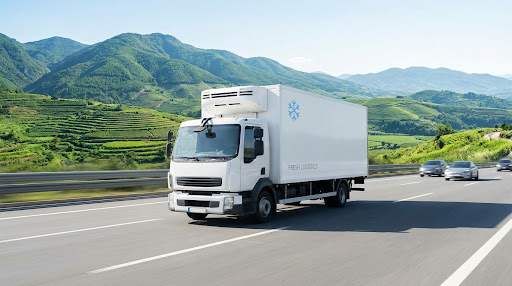
The refrigerated truck fleet serving the corridor has grown substantially since 2021. Established logistics operators including Yunnan Zhongyun Cold Chain and several Xishuangbanna-based carriers run purpose-built reefer trucks with ISO-compliant temperature data loggers — a requirement for food exporters who need to document cold-chain integrity for customs and buyer audits. The trucks are fitted with independent diesel-powered refrigeration units so the cargo hold maintains temperature regardless of whether the truck engine is running. This matters at the border, where trucks can queue for several hours under subtropical sun.
Customs procedure for food is handled through a dual-track system. The Mohan automated clearance platform pre-processes manifests electronically before the truck arrives, so routine shipments with compliant documentation — correct HS codes, complete inspection certificates, valid phytosanitary records — can be cleared in two to four hours rather than the full-day processing that was standard before 2020. Temperature-sensitive goods flagged in the manifest are routed to a dedicated inspection lane with covered, refrigerated inspection bays, reducing cargo exposure time during physical checks.
On the Lao side, the Boten SEZ operates its own logistics park with cold storage linked by an 800-metre internal road to the Chinese customs facility. Goods that clear Chinese export customs and Lao import customs can be transferred between facilities without breaking the cold chain. For goods transiting onward to Vientiane or other Lao cities, refrigerated trucks continue south on National Route 13, a road that has been progressively upgraded since the railway project brought ancillary infrastructure investment to the entire corridor.
Overland vs sea freight: the numbers that matter for perishables
For ambient goods — canned food, dry goods, industrial products — sea freight from South China to Southeast Asia is usually the right answer. The cost per tonne is lower and the slowness does not matter. For perishables, the calculation inverts completely.
Sea route: Guangzhou to Vientiane, 15–25 days
A typical routing from Guangzhou or Shenzhen port to Singapore takes 3–5 days of ocean transit, then onwards to Bangkok or Laem Chabang followed by truck into Laos. Door-to-door, Guangzhou to a Vientiane cold store runs 15–25 days under normal conditions. That total includes port handling at origin, transshipment in Singapore, overland final leg into Laos, and Lao import customs. Refrigerated FCL costs from South China to Singapore run approximately USD 2,500–3,500 per 20-foot reefer container depending on season; add transshipment fees and inland freight to Vientiane and total landed logistics cost reaches USD 4,000–6,000 per container.
Overland route: Yunnan to Vientiane, 36–48 hours
Refrigerated truck from Kunming to Vientiane via the Mohan–Boten crossing: 36–48 hours door-to-door under normal conditions. This is a consistent operational figure for experienced carriers who run this route regularly, not a theoretical minimum. Customs at Mohan adds 2–6 hours for compliant food shipments with pre-filed documentation. Cost per reefer truck — roughly equivalent in cargo capacity to a 20-foot container — runs approximately USD 1,800–2,800 depending on load, seasonality, and whether the carrier has return freight to offset the cost of the southbound leg.
The freshness arithmetic
An unpasteurized fresh beer with a 30-day total shelf life loses roughly 60–80 percent of its usable freshness window on a 15–25-day sea route before the importer even receives it. The same beer on a 2-day overland route arrives with 27 or 28 days remaining. That is not a marginal difference in commercial terms — it is the difference between a viable retail product and one that cannot be sold before it expires.
Sea freight also introduces variables that overland largely avoids: port congestion (Singapore has seen delays of 3–7 days during peak periods), tropical ambient temperatures in non-refrigerated port handling areas between unloading and reefer pickup, and the greater number of carrier handoffs that each add a potential break in temperature records. A cold chain that relies on sea freight is inherently more complex to audit and more vulnerable to compounding delays.
Documentation for food export through Mohan: the full picture
Export of food and beverages through Mohan is well-understood by customs brokers and freight forwarders who specialize in the Yunnan–Laos corridor. The documentation stack is predictable, but first-time food exporters consistently underestimate the lead time required to assemble it correctly before the first shipment can move.
Chinese export documentation
The core documents from the Chinese side are the export customs declaration (报关单), commercial invoice, packing list, and the GACC food safety export certificate — General Administration of Customs China. For alcoholic beverages, the GACC certificate requires the brewery to be registered on GACC's export food enterprise list; registration takes 4–8 weeks for a first application and is a hard prerequisite, not something that can be expedited at the border. The Certificate of Origin issued by CCPIT or the local commerce bureau enables preferential tariff treatment under the ASEAN-China Free Trade Area, reducing import duty in Laos from the most-favoured-nation rate to the ACFTA preferential rate — for beer, typically 0–5 percent rather than the standard 35–40 percent.
Lao import documentation
On the Laos side: import customs declaration, import permit from the Lao Ministry of Industry and Commerce, alcohol label approval from the Laos Ministry of Finance (required before commercial sale — label text, ABV, and net volume must match the approved version exactly), and a health certificate. For beer imported for the first time, Laos also requires notification to the Ministry of Health. Lead time for the Lao label approval is typically 3–6 weeks. Import agents in Vientiane who regularly handle Chinese alcohol can compress this by working through established ministry relationships, but the timeline cannot be reduced to zero — the approvals are sequential, not parallel.
Practical timeline for first shipments
Plan 8–12 weeks from decision to first cleared shipment for a new product entering Laos for the first time. GACC registration, ACFTA certificate setup, Lao import permit, and label approval all run partially in parallel but each has its own queue. Once documentation is in order, repeat shipments move quickly — the same cleared product with the same approved labels can clear customs at Mohan within 48 hours of the truck's arrival at the border. The documentation burden falls almost entirely on the setup phase, not on ongoing operations.
The documentation process is genuinely manageable with the right partner on each side of the border. The mistake most first-time food exporters make is starting paperwork too late, then discovering that a perishable product with a fixed freshness window cannot wait months for a documentation queue to clear. Starting documentation before the first production run is not premature — it is cold-chain planning.
Why fresh beer benefits more from this corridor than almost any other product
The Mohan corridor's primary beneficiaries are not the bulk commodity traders who drove its original growth. They are producers of time-sensitive, temperature-sensitive goods that simply cannot afford what sea freight costs in days and complexity. This category includes fresh Yunnan highland produce — strawberries, cherries, stone fruit — which now reach Vientiane restaurant tables within 36 hours of harvest, pasteurized dairy products with 21-day shelf lives, and fresh beer.
Fresh beer is in some ways the most demanding member of this group. Produce can tolerate brief temperature excursions without becoming immediately unsellable — a slightly warm cherry still has commercial value. Unpasteurized beer held at the wrong temperature for even a short period accelerates staling in ways that are irreversible and not visually detectable. A buyer who receives beer that looks fine but tastes flat and stale has no recourse except to complain. The cold-chain discipline required for fresh beer is therefore a stress test for the entire corridor's perishable handling capability.
That is precisely why the Mohan corridor's investment in temperature-controlled inspection bays and pre-clearance digital customs matters specifically to fresh beer exporters. The one point in the journey where the shipper loses direct control of the product — the border crossing itself — is now the least risky it has ever been. Covered inspection lanes mean the reefer truck does not sit in the sun for four hours with the customs inspector reviewing documents outside in the heat. Pre-filed manifests mean delays are measured in hours rather than days.
JINGDU's logistics route through Mohan
JINGDU Whale Capital Brewery (鲸都鲜酿) brews in Yunnan, approximately 450 km by road from the Mohan crossing — roughly 6–8 hours of truck time on the Kunming–Xishuangbanna expressway. Kegs and bottles leave the brewery at 2–4 °C in sealed, temperature-logged reefer trucks. The Mohan customs manifest is pre-submitted 24 hours before the truck departs the brewery, so by the time the vehicle arrives at the border, the filing is already in the system and the inspection is expedited to the cold-cargo lane.
From Boten the truck continues on National Route 13 through Luang Namtha and Vang Vieng to Vientiane — approximately 700 km of road in progressively improving condition since the railway corridor investment. Total brewery-to-Vientiane cold store time: 36–48 hours. The beer arrives with a continuous temperature log the importer can read, a GACC food safety certificate Lao customs can verify, and a date code documenting remaining shelf life. JINGDU has operated this route on a monthly cadence for over two years. It is commercially reliable. There are occasional slowdowns around major Chinese public holidays, when truck availability tightens and customs queues extend slightly. We plan around them.
The same infrastructure is enabling distribution to expand beyond Vientiane. Distributors in Luang Prabang, Pakse, and Savannakhet now receive fresh-beer shipments by breaking bulk at the Vientiane cold store — a model that works because the 36–48-hour overland route preserves enough of the freshness window to allow one additional redistribution leg. That is the compounding advantage of short transit: margin to distribute widely without expiring early. We are two days from our core market, not three weeks.
Frequently asked questions
How long does it take to move refrigerated goods from Kunming to Vientiane?
By refrigerated truck via the Mohan–Boten crossing and the Laos national road network, Kunming to Vientiane takes approximately 36–48 hours under normal customs conditions. The opening of the Laos–China Railway has added a faster option for goods that can be containerised for rail transport: the Kunming–Vientiane rail route is 1,035 km and takes approximately 9–10 hours of running time, with loading and customs adding 12–24 hours. For JINGDU's fresh-draft beer, the refrigerated truck route currently offers the best combination of cost, cold-chain reliability, and delivery frequency.
What customs documentation is required for beer export through Mohan?
For beer export from China through Mohan into Laos, required documentation typically includes: export customs declaration, commercial invoice, packing list, Certificate of Origin (for preferential tariff treatment under ASEAN-China FTA), product registration or import permit from Laos customs, Chinese food safety export certificate (from GACC — General Administration of Customs China), alcohol label approval from Laos Ministry of Finance, and health certificate. Lead time for first-time exports is typically 4–8 weeks to complete all documentation; repeat shipments are faster once the product is registered.
Is the Mohan corridor reliable for regular commercial shipments?
It has become substantially more reliable since the railway opened in 2021 and since Mohan was formally designated a free-trade zone in 2022. Vehicle queues that previously caused multi-day delays at the border have been reduced by pre-clearance digital customs systems. For food exporters, the Mohan inspection system has invested in temperature-controlled inspection facilities. JINGDU has operated this route regularly for over two years and considers it commercially reliable for monthly fresh-beer shipments, with occasional seasonal slowdowns during major Chinese holidays.
Interested in fresh beer delivered through this corridor?
Tell us your market, your volume requirements, and your target delivery cadence. We will walk you through formats, documentation requirements, and the cold-chain logistics plan for your route. Contact us for MOQ, lead time and a quote.